
Thriving in a new reality of fractured information
In an environment of hyper-cluttered and outright fractured information, how do your brand message and perceptions of your value proposition stand out? A seismic shift in trust and content led by digital content creators and technology advances has fractured once-standard traditional communication. Personalities trump facts. New platforms buffet perception and understanding. Platforms and content differ almost wildly, some with outrage, sarcasm, and labeling strategies dominating as consumer-attracting news-tainment.
How do companies communicate in this environment? What does effective marketing and public relations look like in 2025?
And how can you defend and protect your brand and reputation?
Following are some key trends to consider: traditional news outlets that once dominated the information landscape are watching their influence wane and drain as audiences — particularly younger demographics – rapidly turn to alternative sources for news and insights. (for instance, among many others, how about the obvious election and societal-influencing “Joe Rogan Experience,” or thousands of channels and commentators on Reddit or YouTube?) For brands and organizations, this transformation presents both unprecedented challenges and new opportunities.
The rise of independent media
Gone – perhaps almost far gone – are the days when reaching your audience meant securing media coverage or placing ads in newspapers or on radio or television networks. Today’s media ecosystem includes the explosive growth of independent creators, including Substack influencers, podcasts, and trusted personalities who have built dedicated followings. These alternative voices aren’t just supplementing traditional media—they’re increasingly replacing it as primary information sources.
The key point? This shift represents more than just a change in format; it’s a fundamental transformation in how audiences discover, consume, and trust information. Independent media creators often enjoy higher levels of audience trust and engagement than their traditional counterparts, making them powerful influencers in shaping public opinion.
Social media as political identity
Perhaps nowhere is this media fragmentation more visible than on social media platforms themselves. The choice between BlueSky, X (formerly Twitter), and Truth Social has evolved beyond simple platform preference—it now serves as a digital badge of political and social identity. Users self-select into echo chambers that align with their existing beliefs, creating what experts call powerful confirmation bias effects.
This platform polarization creates significant communication barriers for brands. A message that resonates on one platform may fall flat or even backfire on another, making broad-reach campaigns increasingly complex and potentially counterproductive.
The algorithm-driven information diet
Modern consumers don’t just choose their platforms—they allow sophisticated algorithms to curate their information diet. These AI-powered systems create personalized feeds that tend to reinforce existing viewpoints rather than challenge them. The result is an increasingly polarized audience base where different segments of your market may be operating with entirely different sets of “facts” and assumptions.
This algorithmic curation makes it more difficult than ever for brands to ensure their messages reach diverse audiences with accurate, consistent information.
The Disinformation Challenge
As traditional fact-checking mechanisms weaken—with some social media platforms abandoning these roles entirely—disinformation has become a more pressing threat. While AI tools can amplify false information, the real danger comes from human actors who deliberately spread misleading content for political or economic gain.
For brands, this means that negative or false information about your company, products, or industry can spread rapidly through alternative media channels before traditional oversight mechanisms can respond. Introduce AI-powered synthetic influencers and the threat just intensifies.
Can you tell the difference between real video and deep fakes? Take this New York Times online quiz – you might find yourself surprised, perhaps a little shocked.
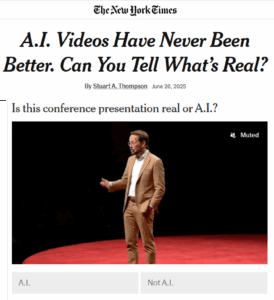
This doesn’t mean that companies, communication professionals (marketing and PR) are helpless by any means. But it does mean that the rules have changed and are continuing to change.
What this means for your brand and your company
Expand your monitoring – Here’s an obvious one, but one that needs emphasizing: your media monitoring strategy can no longer focus solely on traditional outlets. You need to track influential newsletters, podcasts, social media personalities, and platform-specific conversations that could impact your brand’s reputation.
Speed is critical – In this new landscape, the window for responding to misinformation or negative coverage has shrunk dramatically. Crisis management now refers to the “golden hour,” where effective response must concur within minutes instead of hours or even days. Online anger spreads faster than ever, and ignoring negative narratives while they gain momentum can have serious consequences for your reputation and bottom line.
Audience-specific communication – The fragmentation of media means one-size-fits-all communication strategies are becoming obsolete (if they haven’t already) . Success requires understanding the specific platforms, personalities, and information sources that influence each segment of your audience, then tailoring your approach accordingly. That means different platforms and content contoured by age and cultural demographics.
Transparency is non-negotiable – Modern audiences demand authenticity and transparency. Any attempt to manipulate or obscure information is likely to backfire in an environment where alternative media personalities pride themselves on exposing corporate spin. Now more than ever, “spin” is indeed a four-letter word. Its practice today can be lethal to your brand and reputation.
Relationship building still matters – While the media landscape has changed and AI is definitely speeding things up, the importance of building genuine relationships with information gatekeepers remains crucial. That’s Crucial with a capital C. This now includes not just traditional journalists, but also newsletter writers, podcast hosts, and social media influencers who attract and now command audience trust.
What can you and your company do?
Strategic recommendations
Elevate communications leadership: Given the complexity of today’s media environment, communications professionals need a seat at the executive table. The iceberg effect of modern media—where much of the conversation happens in private messages and closed networks—requires sophisticated monitoring and response strategies. Real-time response requires real-time engagement.
Embrace multiple channels: No single platform or publication can effectively reach all your audiences. Develop a multi-channel approach that recognizes the unique characteristics and audiences of different media formats. That includes digital challenges – many of which evolve daily.
Invest in real relationships: Focus on building authentic relationships with the media personalities and platforms that matter most to your audiences. This includes both traditional journalists and emerging independent voices.
Use AI wisely: While artificial intelligence can be valuable for research and content refinement, don’t let it replace original thinking and authentic voice. Audiences can increasingly detect AI-generated content, which can trash both reputation and trust. Authenticity remains paramount and is earned by humans communicating directly with humans.
Realize that change is here to stay
The media landscape will continue evolving rapidly, driven by technological advancement, changing audience preferences, and political polarization. Brands that adapt their communication strategies to this new reality—embracing transparency, building diverse media relationships, and responding quickly to emerging narratives—will be best positioned to maintain trust and influence in an increasingly fragmented information environment.
Not that long ago some 60-70% of the practice of public relations focused on media relations – creating opportunities for media coverage. That playbook and its marketing antecedents have been rewritten for advertising and PR alike. In fact, as was noted at the recent Cannes festival, the word “agency” (as in advertising agency) became a moniker of old-style thinking. It happened that fast.
Today the question isn’t whether these changes will affect brands and perceptions—it’s whether companies will adapt quickly enough to thrive in a reality where media changes almost daily.
Where’s your company — and your value proposition — stand?
By Michael Snyder, MEK