Client News
Ask around and you’ll have a hard time finding an adult who hasn’t thrown their back out at least once. Whether from lifting a heavy sack, hoisting a grandchild, or simply bending over to pick up a dropped phone, back problems can come out of seemingly nowhere.
How common is it? Back pain is one of the top three reasons people call a doctor’s office, right alongside colds and the flu. Unlike a cold, back pain has a way of parking itself in the middle of your life until you can’t work, sleep, or sit through church without shifting uncomfortably in the pew.
Presently suffering from back pain? Here’s some good news. Most back pain is not a sign that something is seriously wrong. Here’s even better news: there’s a lot you can do about it.
VINCENNES (Indiana) – American farmers often face cumbersome regulatory and compounded reporting issues that hamper both their expansion opportunities and worse, the capacity to effectively sustain operations. Fallow AG, a new fintech company based here, strategically focuses on addressing and resolving those critical issues—including capital access–through innovative data-driven means.
According to Naveed Iqbal, CEO of Fallow AG, this significant challenge for farmers is reflected in an annual acreage report that the U.S. Department of Agriculture requires as a condition of most federal farm programs. Since crop and production performance can occasionally be adversely affected by drought and other issues, the information formally filed on that acreage report reappears in disaster and loss claims. It also has to square with a second acreage report the farmer files with its crop insurance provider.
The information required on the forms does not reflect modern farm operations. “The farmer is essentially asked to produce a document that has almost nothing to do with how the operation actually runs,” said Iqbal.
The net effect? A poor and inadequate record of a farming operation can emerge, especially in complicated operations. That record produced by that process can negatively impact farmers in a major way.
Educator. Global healthcare education service. Passion for practicing rural medicine, especially in filling gaps in obstetric services.
A new physician at the Paoli clinic of Southern Indiana Community Health Care (SICHC), Kara Beth Thompson, M.D., MEHP addresses a broad spectrum in rural healthcare in addition to her role as a family physician. “SICHC provides a critical role in meeting many medical challenges unique to rural areas,” explained Dr. Thompson. “A pregnant woman in a rural area can face significant travel and other issues from prenatal to delivery, which can create a high-risk situation.”
As AI use moves into operational use in your organization, picture these scenarios: a marketing manager uploads a confidential competitive strategy document to a free AI summarization tool to save an hour of reading. A financial analyst feeds customer account data into an unauthorized AI platform to speed up a quarterly report. A software engineer pastes proprietary source code into a public chatbot to debug a tricky function.
None of them intends any harm. Productivity actually jumped as result of AI speed and support.
But all of them just created a serious security incident. And no one in the IT department knows it happened.

Welcome to the age of Shadow AI. Whatever your level in an Indiana company — a CEO, IT manager, or someone who is just trying to deal with under-staffed needs — this issue requires your attention.
Heard of Shadow IT but not Shadow AI? Shadow AI refers to the use of artificial intelligence tools and platforms within an organization without the knowledge, approval, or oversight of IT or security teams. It is, at its core, a faster, more dangerous evolution of “Shadow IT” — the old problem of employees using unsanctioned apps and cloud services.
This column also appeared on Inside Indiana Business – used with permission.
A quiet transformation is changing Indiana agriculture and agribusiness—one driven not by a new hybrid seed or a more powerful piece of farm equipment, but by a strand of glass thinner than a human hair. As showcased earlier at CES 2026, life on the farm now increasingly includes AI-powered innovation and tech-enabled productivity gains.

The key point? High-speed fiber-based broadband today represents a “must-have” platform for high-yield farms and agricultural production, and the communities and regions that bring this fiber platform to their agricultural lands aren’t just investing in internet service. They’re investing in the baseline future of food production itself.
Quantified by research, the stakes are unmistakably clear. A USDA report found that deploying broadband and next-generation precision agriculture technologies across U.S. farms and ranches could generate at least $47 billion in national economic benefits every year — and that more than one-third of those gains are dependent on broadband connectivity alone. The represents an astonishing $18 billion annual economic value that only high-speed, reliable internet can unlock, especially as AI applications accelerate autonomous equipment deployment and real-time crop analysis. That isn’t a rounding error.
That’s a figure large enough to reshape rural economies from coast to coast.
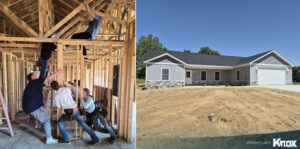
VINCENNES — On one street in Vincennes, high school seniors recently finished framing, wiring and finishing their first three-bedroom house. A few blocks away, the first 24 units of a $35 million apartment complex are being readied for mid-June move-ins. Twenty miles up the road in Bicknell, the city has been selling vacant lots for as little as $1,000–and watching more than 20 new homes rise in their place.
Knox County, by almost any measure, is in the middle of a housing surge. The new housing comes just in time to help accommodate new resident growth through the MakeMyMove initiative and other attraction programs.
“The county is now engaged in several different types of housing development, which is key to successful population growth and talent attraction,” said Chris Pfaff, CEO of Knox County Indiana Economic Development (KCIED). The activity spans market-rate apartments renovated historic homes, new single-family construction and even classroom-built starter homes—much of it tracing its origins to a unified study commissioned a few years ago.
A $35 million flagship
The largest project, Bierhaus Flats, will offer 240 one-, two- and three-bedroom apartments at market rate, all well-under construction. The first 24 units will be ready for tenants in mid-June, said Phil Reinbrecht, president of Simplified Developments, the firm behind the build.
As this is published, today is World Quantum Day, a day observed annually on April 14. For those interested, the date was chosen to honor the first three digits of Planck’s constant (4.14 × 10⁻¹⁵ electron-volts per second), the mathematical bedrock of quantum physics itself.
Why is this relevant? What began as a grassroots effort among scientists and educators has grown into a global opportunity that is moving steadily from theory into infrastructure. Accordingly, on Quantum Day 2026 it seems an especially fitting moment to review where quantum computing stands, including Indiana’s place in that emerging revolution.
Theory moving toward reality
When this column first appeared in January 2025 (the year of Quantum Computing), quantum computing was the technology equivalent of a distant rumor: fascinating, plausible, but vague in its timelines and commercial implications.
No more.
VINCENNES – After a year of research, product development and real-world business experience, seven Knox County high school entrepreneurs will display – and offer for sale – products and services they created through the Knox County CEO program at the annual CEO Trade Show on Sunday, April 12. The event is open to the public from noon to 3 p.m. in the Green Auditorium on the Vincennes University campus.

Showcasing their work from the 2025-2026 program year, the students will offer a variety of products and services, including candles, body butters, bracelets, all-natural car detailing supplies, 3D-printed license plates, photography and professionally produced sourdough bread.