
What makes a good leader?
Every organization has watched it happen. The most confident person in the room rises into a leadership role, and within a year the team is quietly struggling. New research helps explain why—and gives executives a more precise way to identify and develop the people who will actually lead well.
In a recent meta-analysis in the Journal of Applied Psychology, Dr. Nathan Baker of Wright State University and his colleagues synthesized 203 datasets and nearly 5,000 correlations to examine how personality relates to two distinct outcomes: leader emergence (who is perceived as leaderlike and rises into the role) and leader effectiveness (who actually performs once there).
 Their central contribution is a shift in resolution. Rather than measuring broad traits like extraversion or conscientiousness, Baker’s team examined 21 narrow “facets” beneath them. That difference matters more than you might expect.
Emergence vs Effectiveness
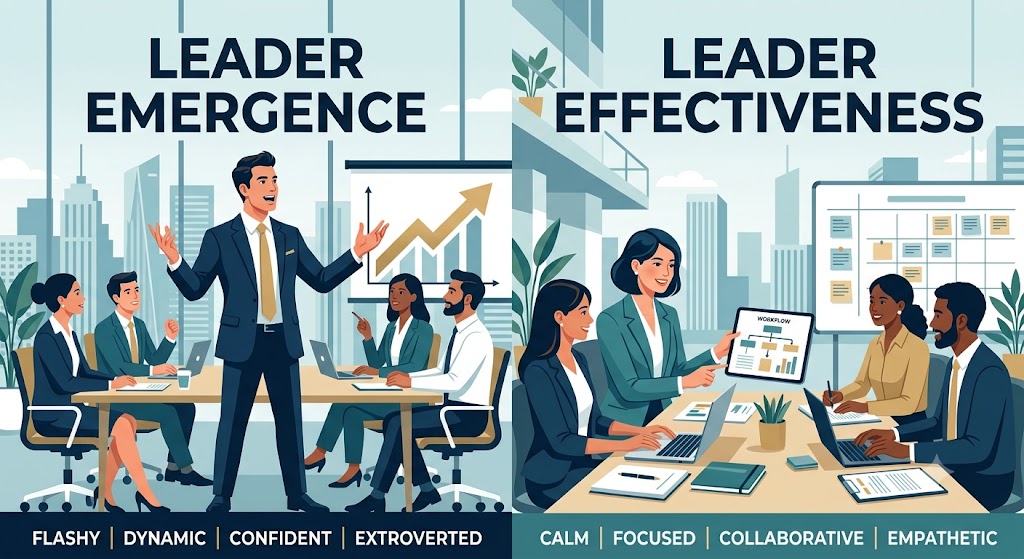
Here is the first lesson for any leadership team: emergence and effectiveness are not the same thing, and they reward different characteristics. Assertiveness—the drive to speak up, take control of a conversation, and claim social status—was the single strongest personality predictor of who emerges as a leader. But its link to actual effectiveness was considerably weaker.
In other words, the traits that get someone noticed and promoted often have little to do with whether they will succeed in the job. Organizations that let confidence and visibility drive appointments are, in effect, selecting for the wrong thing.
Overlooked: the quiet, more effective, leader
More striking still are the facets that reverse direction entirely. Altruism—a genuine concern for others—was positively related to effectiveness but negatively related to emergence. Self-discipline and order predicted effectiveness strongly yet had essentially no relationship, or a slightly negative one, with emergence.
The quiet, conscientious, other-oriented contributor is frequently overlooked precisely because those qualities don’t announce themselves.
Key indicators – optimism and positive leadership
So what actually predicts effectiveness? Baker’s team found the strongest signals in a handful of specific facets: achievement motivation, order, and self-discipline (all facets of conscientiousness), along with optimism and stress resistance (facets of emotional stability).
Optimism deserves particular attention. It outperformed the broad emotional-stability trait and, notably, mattered most for senior leaders—the higher the level, the more a leader’s ability to see goals as attainable and set a positive tone shaped outcomes. Meanwhile, several facets that intuition might favor performed poorly: empathy and ingenuity showed surprisingly weak or negligible relationships with effectiveness once measured precisely.
One size does not fit all
The context finding is equally practical. The characteristics that predict effective leadership shift with organizational level. Conscientiousness facets that strongly predicted success for students and early-career leaders were weak—even negative—predictors for senior executives.
Optimism, by contrast, became more valuable as leaders climbed. This is a direct caution against one-size-fits-all leadership models: the profile that works for a shift supervisor is not the profile that works for a C-suite officer.
Making a significant difference
Finally, the research carries a message about measurement itself. When Baker’s team combined facets into optimally weighted composites, prediction improved substantially over broad traits—in the case of openness, more than doubling.
The practical takeaway is that organizations can build shorter, sharper assessments focused on the few facets that matter for a specific role, rather than long, generic trait inventories.
For executives and boards, several actions follow.
- First, separate your emergence pipeline from your effectiveness criteria—the people who look like leaders in meetings are not automatically your best bets, and some of your strongest performers may never self-nominate.
- Second, in selection and development, weight the facets the evidence supports: achievement drive, discipline, follow-through, stress resilience, and, especially for senior roles, optimism.
- Third, calibrate to level; revisit whether the competency models you use for frontline supervisors are quietly being applied to executive selection. Fourth, treat empathy and charisma as valuable human qualities but not as reliable proxies for leadership capacity.
None of this argues that personality is destiny. As Baker and his coauthors are careful to note, leadership is a complex process shaped by behavior, relationships, and decision-making, and personality is only one piece of a larger puzzle. But it is a piece we can now read with far greater precision.
The organizations that benefit most will be those willing to look past the loudest voice—and to build their leadership benches on the quieter traits that actually get the work done.
By Michael Snyder, MEK Group
Source: Baker, N., Scott, W., Nye, C. D., Chernyshenko, O. S., Park, H. W., & Omori, C. L. (2026). The many facets of leadership: A meta-analysis of personality facets, leader effectiveness, and emergence. Journal of Applied Psychology.