
Harris Poll – Customers feel stuck and anxious – what can be done?
When anxiety dominates, the company or person who brings hope and relief wins. How can your company, your leadership make a difference?
The 2025 Axios Harris Poll is out – and while some 67% of American consumers feel that “they’re under siege” in the 2025 economy, several opportunities exist.
John Gerzema, CEO of the Harris Poll, outlined key trends in mid-June 2025 of the company 27th Annual Reputation Quotient Study. The recent poll measured character, trust, and corporate trajectory of the top 100 American companies, the latter including an expressed company vision, growth and how the company’s products and services are perceived.
Who came out on top? Trader Joe’s. The dead last position was occupied by Spirit Airlines but kept some surprising company. Americans – including influencers and customers – don’t have much to favor about UnitedHealth, FOX, Telsa, Meta (Facebook) and X (formerly Twitter). Comcast, the once-perennial bottom feeder, has vaulted up the brand food chain to 83.
Current sentiment
Gerzema warned for companies and corporate leadership alike that there is presently “a lot of concern over economics,” including the fact that research shows that “tariffs have thrown incredible anxiety into American households.” (And bonus point – this anxiety trend is complicated by AI implementation – see further down)
As the poll ominously notes, there’s a reason: “Amid inflation, nearly half (46%) of companies declined in 2025.”
The top Harris take-aways – what is current consumer sentiment coming off the first quarter of 2025?
- 77% say companies “often sell lower-quality products and services while charging higher prices.”
- 70% “believe companies are taking further advantage of inflation to increase their profit margins.”
- 60% “feel companies will use tariffs as an opportunity to raise prices more than needed to boost profits.”
The outcome, according to Harris research? “Americans feel stuck and scared.” More than half polled (61%) said that the U.S. economy has negatively affected at least one “major life goals in 2025.”
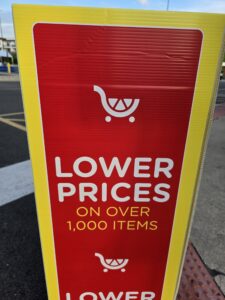
Regarding purchases and life changes (like switching a job) the majority polled in the research say they either “cannot afford this anymore” or “don’t feel comfortable doing in this economy.” The affected goals? “Getting married, having a child, making a large purchase, switching jobs, buying a house.”
The headline version from Harris? “Americans putting life on hold amid economic anxiety under Trump.”
In this environment, what can companies do? How can leadership make a difference?
Value creation
Harris found that companies who have built reputations of trust and are sticking by values that openly favor consumers are finding favor with both customers and influencers. These reputations are built on fact, not rhetoric. For example, when egg prices were skyrocketing, Trader Joe’s changed their supply chains to buy directly from farmers and engaged customers to conserve. Customers – and the media – not only rewarded Trader Joe’s by buying eggs, but by elevating their brand through word-of-mouth.
A supposed commodity retailer, AriZona Iced Tea, scored high with believable messaging that they have been “fighting inflation since ‘92” and overtly holding steady. That resonated across the board and boosted AriZona’s brand placement up to a highly trusted No. 7 position in the Harris poll.
The point from Harris? “Consumer champions are winning on reputation.”
Harris – Americans are not yet largely confident with AI
As economic instability keeps Americans up at night, so does AI use. Harris found that people had a specific message to businesses about AI: “take it slow.”
A full 91% of Boomer Americans want businesses to “take AI slow and do it right.” Some 74% of Gen Z and 77% Gen X Americans agree. The message that “AI will replace you” doesn’t resonate well with just everybody. Some 75% of people are also unhappy that AI development seems to be dominated by a growing monopoly of companies.
Separately, anxiety over job impact also continues to heighten, as the Wall Street Journal reported in early July that CEOs are starting to acknowledge that “AI will wipe out jobs.”
The point? Despite what is happening with the rebranding of advertising agencies as “technology companies” (as opposed to “agencies”) this probably isn’t the time to generally tout your AI portfolio of services.
Leadership critical
According to Harris, being faithful to stated corporate values – especially those of service and commitment – represents a key leadership advantage. CEO Gerzema noted in his remarks that “cheap words” not backed up by action can harm reputations, even to lethal levels.
Gerzema also noted that a decline in reputation often is followed by a decline in revenue, which will get the attention of CEO and shareholders alike. He noted that “the [reputation and trust] bar has been elevated.” CEOs and leaders should also be sensitive to the fact that in this current environment of anxiety, the “Pricing P of the four P’s in marketing [Product, Price, Place and Promotion] is most important.”
Business and consumers alike “hate uncertainty,” according to Gerzema. In times of change like today, Gerzema said that research encourages leaders to “fortify your reputation as an ally” with consumers and influencers, reinforcing perceptions as an “inflation fighter” with believable words backed up by actions.
Now, he says, is a good time to dust off your company’s value proposition and reinforce it with “empathy – does the American public believe that you are their ally?” Is your company creating real, tangible value for your customers and stakeholders, whether for-profit or not-of-profit?
Be a leader who brings hope and relief. CEOs and leaders can make a difference, attracting and retaining customers, supporters and influencers in times of uncertainty and change.
By Michael Snyder, Managing Principal, MEK