
The Seven Rules that saved Star Trek — and still govern great content
A 1966 writers’ brief is better guidance for 21st century B2B content marketing than much of what’s published on the subject today.
Star date 09.08.2026
In 1966, Variety screened a new NBC science fiction series and delivered its verdict: it “won’t work.”
Sixty years later, that stands as one of the more expensive misreads in television history. Star Trek premiered Sept. 8, 1966. It was nearly dead before it launched, cancelled after three seasons, and then — like the Tribbles — multiplied relentlessly in syndication into a franchise that has not been off the air for long since.
For anyone who produces content professionally, the interesting question isn’t why Variety got it wrong. It’s why the thing kept working. Sixty years. A dozen series. Audiences who weren’t born when it premiered and have no nostalgia to trade on.
Part of the answer is a document.
The brief that outranked the Prime Directive
The show’s beginning was ugly. Gene Roddenberry pitched it as a “wagon train to the stars,” then delivered a first pilot that was cerebral, expensive, and off-target — a story about thought control that NBC declined. In a move nearly unheard of then or now, the network ordered a second pilot. The cast we know arrived. The series went on the air.
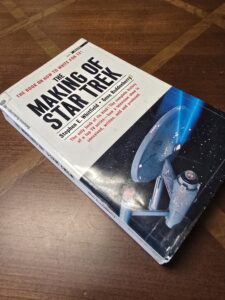
What came with it was a working document. Every writer who came aboard between 1966 and 1969 received the Star Trek Guide — the show’s bible, telling freelancers what the series was, what it wasn’t, and what a script had to accomplish before anyone would read past page one. Seven rules in that guide, later recounted in the 1968 book The Making of Star Trek, did most of the heavy lifting.
Paraphrased, they represent the sharpest content brief I’ve encountered — written by television professionals who had never heard the phrase “content marketing.”
Here they are, with what each one means if your job is moving a B2B audience.
1. Build on an action-adventure framework
The guide’s reasoning was blunt: the show had to reach and hold roughly 20 million people, or it didn’t stay on the air.
Your content faces the same arithmetic in harsher terms. A LinkedIn article doesn’t compete with your competitor’s white paper. It competes with everything else in the feed — and the audience’s thumb is the network executive. Structure earns attention: a real opening, movement, consequence. A post that opens with “In today’s rapidly evolving landscape” has already been cancelled.
2. Tell stories about people, not science and gadgetry
This is the rule most B2B content violates before the second paragraph.
Your platform’s architecture is not the story. The hospital administrator deciding whether a rural service line survives is the story. The economic development director with one shot at a site selector is the story. The plant manager who inherited a workforce problem is the story. Specifications belong in the piece — as evidence, not as protagonist.
3. Science fiction isn’t a separate genre with its own rules
The guide reminded writers that a science fiction story needs everything any other story needs: jeopardy, motivation, a climactic build.
B2B isn’t a separate genre either. Technical audiences are still audiences. The CFO reading your case study is the same person who watched a documentary last night and decided in ninety seconds whether to keep watching. Complexity and difficulty are not the same thing, and a subject-matter expert has never once complained that a piece was too clear.
4. Have something to say — and say it entertainingly
The guide told writers to interweave a statement about people and society into that firm foundation, then added the essential qualifier: however brilliant, essays weren’t wanted.
The point? High-impact thought leadership is earned, not asserted. A genuine point of view — one that costs you something, that a competitor could plausibly disagree with — represents the whole game.
But it has to be carried by a story, not delivered as a lecture. Most “thought leadership” fails on the second half: it has a thesis and no vehicle.
5. Star Trek is never fantasy
However strange the episode, the guide insisted it be grounded in fact or theory and stay true to that premise.
In an age of AI slop, this rule has quietly become the most valuable of the seven. Generative tools have made plausible-sounding content free and infinite. What is not free is verifiable: named sources, real numbers, a client who agreed to be quoted, a claim you’d defend in a deposition. Credibility and authenticity are now the differentiators, and audiences are getting faster at spotting the absence of same.
6. Don’t try to tell a story about whole civilizations
Scope discipline. The guide warned writers off galactic sweep because it flattens everything into interest-sapping abstraction.
Want an example? “Digital transformation in healthcare” is a civilization. One rural hospital deciding between closing obstetrics and finding a partner is an episode. Broadband’s economic impact is a civilization. The impact of a fiber build that enables one manufacturer keep a second shift is an episode. Narrow the frame and the meaning appears; widen it and you get a category, not a story.
7. Stop worrying about being a scientist
The guide’s closing reassurance: how many working cowboys, police officers, or doctors wrote the Westerns, detective shows, and hospital dramas of the era?
Marketers serving technical clients tie themselves in knots over this. You do not need to be the engineer, the physician, or the site selector. You need to research and interview them well, understand enough to ask the second question, and know how to build the thing they can’t build.
Deference to expertise is right. Deferring the storytelling to the expert is usually a mistake — that’s how you get a 3,000-word piece that reads like a compliance filing.
What’s your Prime Directive?
The rules themselves matter less than the fact of them. Star Trek’s writers weren’t more talented than everyone else’s writers. They were working from a shared standard, on paper, that everyone had to meet — and that standard held long enough for syndication to find the audience the network had given up on.
Most organizations don’t have one. They have a brand style guide about logo clear-space and a content calendar that lists topics and due dates. Neither one tells a writer what a piece has to accomplish before it’s worth publishing.
So: does your content tell stories about people? Would a stranger finish it? Could you defend every claim in it? Does the organization have a standard in writing that team members and executives can succeed on, or a set of habits everyone assumes they share?
Sixty years of evidence suggests the document–even the process–is worth the afternoon it takes to write.