
Why shadow AI risk can be your most dangerous blind spot
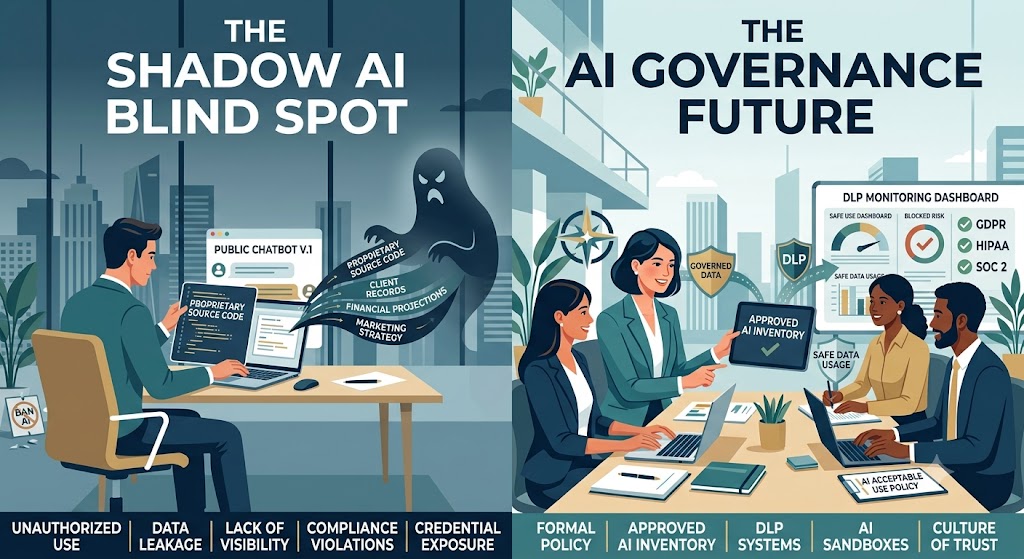
As AI use moves into operational use in your organization, picture these scenarios: a marketing manager uploads a confidential competitive strategy document to a free AI summarization tool to save an hour of reading. A financial analyst feeds customer account data into an unauthorized AI platform to speed up a quarterly report. A software engineer pastes proprietary source code into a public chatbot to debug a tricky function.
None of them intends any harm. Productivity actually jumped as result of AI speed and support.
But all of them just created a serious security incident. And no one in the IT department knows it happened.

Welcome to the age of Shadow AI. Whatever your level in an Indiana company — a CEO, IT manager, or someone who is just trying to deal with under-staffed needs — this issue requires your attention.
Heard of Shadow IT but not Shadow AI? Shadow AI refers to the use of artificial intelligence tools and platforms within an organization without the knowledge, approval, or oversight of IT or security teams. It is, at its core, a faster, more dangerous evolution of “Shadow IT” — the old problem of employees using unsanctioned apps and cloud services.
This column also appeared on Inside Indiana Business – used with permission.
A possible catastrophe in the making
But back in the day when a rogue Dropbox account simply inconvenienced staff, Shadow AI is potentially catastrophic. Why? The tools are more powerful, the data exposure is deeper, and the risks compound at a speed that legacy security frameworks simply weren’t built to handle.
Unfortunately, the current numbers are staggering. More than 80% of workers — including some 90% of security professionals — use unapproved AI tools in their jobs, according to UpGuard’s 2025 research (Upguard risk template here). Perhaps most unsettling, roughly 38% of employees share confidential data with AI platforms without authorization, according to research by CybSafe and the National Cybersecurity Alliance.
 And the executives who are supposed to set the tone (and the usage policies)? They are among the most frequent regular users of unauthorized tools.
The scale and velocity of this problem holds unprecedented threats. Shadow IT took years to become a widespread problem. Shadow AI achieved that status in months. As a result, there’s likely some form of Shadow AI operating in your company today.
The anatomy of a Shadow AI risk
An immediate danger comes in the form of data leakage. When employees paste information into AI tools, that data can be stored, logged, and potentially used for model training by the platform provider.
Why is this a problem? A single interaction — such as pasting proprietary source code, client records, or financial projections into a public AI interface — can expose information that potentially will live permanently on a third-party server. The sad part? Most employees today have no idea this is happening.
Beyond data leakage, unauthorized AI creates entirely new attack surfaces. Employees often use enterprise credentials to log into public AI systems, potentially exposing those credentials. Unsecured API connections to AI platforms can be intercepted, and IT teams lack visibility into who’s using what, making effective security monitoring nearly impossible.
Ready for a HIPPA compliance violation?
Then there is the compliance dimension. Here’s what everyone is facing: compliance frameworks like GDPR, HIPAA, CCPA, SOC 2, and PCI DSS were not initially created to safely operate in an AI environment. As a result, violations triggered by unauthorized AI use can fall squarely under these regulations.
What does that look like? Under GDPR alone, improperly exposing EU customer data can result in fines of up to 4% of global revenue. In healthcare, a Shadow AI incident that exposes protected health information can ravage a hospital, clinic, or healthcare organization both legally and financially.
The risk is growing as you read this column, and the potential financial exposure is not a theoretical event. According to IBM’s 2025 Cost of Data Breach Report, shadow AI incidents now account for 20% of all breaches. Here’s where your CFO should be concerned: these incidents can carry a higher cost premium, averaging $4.63 million versus $3.96 million for standard widespread organizational breaches.
Why bans don’t work
Some companies and executives respond by trying the instinctive organizational response to simply prohibit or outright ban AI tools.
It doesn’t work. Employees break the rules and adopt these platforms because they are effective, accessible, and embedded in the pace of modern work. Here’s a significant part of the problem: UpGuard found a positive correlation between users who reported understanding AI security requirements and those who regularly used unapproved tools — employees believe they know enough to manage the risk themselves. That assumption can be seriously damaging, even fatal to an organization’s business continuity.
What solution can work?
The answer is not prohibition. It’s governance. Organizations need to build a formal AI Acceptable Use Policy, establish an approved inventory of enterprise-grade AI tools, deploy AI-specific Data Loss Prevention (DLP) systems (which include proprietary software that can monitor and protect organizations from rogue AI usage), and create cross-functional oversight bodies with representation from IT, legal, compliance, and operations.
Equally important is organizational culture advancement. Creating AI sandboxes where employees can test tools safely, and making reporting of unapproved tools a non-punitive, automatic process, shifts the dynamic from policing to partnership.
The Bottom Line – AI governance
Gartner predicts that by 2030, more than 40% of enterprises will experience security or compliance incidents linked to unauthorized Shadow AI. That timeline is accelerating. Organizations that treat AI governance as a future-state initiative — something to address once the technology “matures” — can be making a costly miscalculation.
The tools are already inside your walls. The question is whether you know what they’re doing. The point? AI governance needs to be in your organization’s future.
Want more information about shadow AI and powerful tools of AI governance and critical audit trails? Visit CyberhopeAI.com to see how your organization can be protected without sacrificing speed or productivity (including Industry 4.0 applications).
A serial technology entrepreneur, Rick Barretto has led and built successful technology ventures, including systems like Cyberhope AI that protect strategic AI deployment.
Inquiries and more information: Michael Snyder, MEK Group