
Client News
VINCENNES – Beginning an extensive Japan Trade Mission on Sept. 4, Chris Pfaff, CEO of Knox County Indiana Economic Development (KCIED), noted that “Knox County represents a great fit for Japanese companies, given our strengths in advanced manufacturing, agri-business, logistics, and renewable energy.”
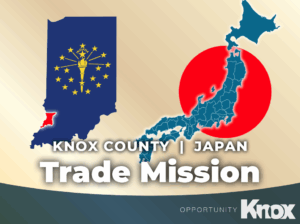 Pfaff and Vincennes Mayor Joe Yochum joined the Mayors of Columbus, Greensburg, Seymour and Wabash and other Indiana economic development and trade professionals to travel to Tokyo, Osaka, and Nagoya for meetings that included the Midwest US – Japan Conference (MWJA) and the World Expo in Japan, which focuses on economic growth and innovation.
(Coverage appeared on Inside Indiana Business, Southern Indiana Business Report and others)
“Okay, what’s it going to really take to get healthier?” We sometimes hear this question in our clinic, usually right after a mention of the words “lifestyle changes.”
 Here’s some good news: getting started on better health doesn’t require an expensive gym membership or giving up pizza forever. For about the same cost as a large fast-food meal you can buy some simple wearable health tech – like a fitness tracker – that might just change your life.
We’re not talking about those fancy $400 smartwatches that cost more than a car payment. We’re talking about basic fitness trackers or used smartwatches in the $20-$40 range. Think of it as hiring a tiny personal trainer for your wrist—one that never yells at you or makes you do endless sit-ups.
Did you know that September is Self-Care Month? This month is a gentle reminder that positively taking care of oneself isn’t self-centered, it’s essential. For many of us, fall is the season when kids are back in school, when our schedules shift, and for some, a time of pumpkin-spiced everything. But while we’re busy keeping calendars in line and wardrobes ready for cooler weather, our own well-being can quietly slip further towards the bottom of the list.
 As a long-time family physician, I can confirm that self-care is more than a one-off pledge to sometimes taking care of business. It’s about steady, everyday choices that protect your body, mind, and emotional health. In fact, many healthcare professionals encourage patients to think of self-care as part of their “prescription for prevention,” an important addition to regular medical checkups and seeing your provider.
Embracing practical and sound self-care works best when it’s part of one’s healthcare journey, walking alongside a trusted provider.
serve as the featured corporate speaker at the Annual Gala of the Japan-America Society
of Indiana (JASI). The 2025 JASI Gala will be held on Wednesday, August 20th, 2025,
at the Indiana Roof Ballroom in Indianapolis.
 The Gala will celebrate the recent historic agreement between Nippon Steel Corporation and United States Steel Corporation. With U.S. Steel’s largest plant located in Gary, Indiana – also the largest integrated steel mill in North America – the agreement is expected to bring major investment and economic benefits to Indiana and the region.
This landmark partnership underscores the enduring strength of the Indiana-Japan relationship and the deepening industrial ties between the United States and Japan.
remarks by Consul-General of Japan in Chicago Masashi Mizobuchi, and City of Gary
Mayor Eddie Melton.
Producing an estimated $7 million in economic impact, some 5,000 families, coaches, 10-year-old players from across America and international areas are taking part in the August 2025 competition.
VINCENNES – In what is described as one of the largest youth sporting events in America, more than 300 top youth baseball players from 14 states and five countries and territories will play 78 games in eight days for the 2025 Cal Ripken 10-Year-Old World Series here. The week-long event is expected to produce upwards of $7 million in economic impact for the Knox County Indiana region.
 Following a number of organizational events, teams will begin competitive play on Saturday, Aug 9. A championship game will conclude the World Series on Saturday, August 16, with teams departing on the 17th.
“It is an honor for us to return to Vincennes with another World Series,” said Bob Connor, Vice President of Operations for Babe Ruth League, Inc. “What kids and their families love best about the Babe Ruth League program are the friendships they build in the communities and beyond – Vincennes is one of the friendliest communities in our program and their love of the game is exceptionally strong.”
“This represents a major event for Vincennes and the region, with players, coaches, and families using available hotel rooms in Vincennes, Princeton, Terre Haute, and more,” said Kirk Bouchie, General Manager of Vincennes Water Utilities, who is serving as the World Series Host President and as President of the Vincennes Cub League. Teams of 10-year-olds are represented from the states of Alabama, California, Connecticut, Hawaii, Idaho, Indiana, Kentucky, Massachusetts, Missouri, New Jersey, New York, North Carolina, Pennsylvania, and Washington, as well as Puerto Rico, Aruba, Germany, Mexico, and the Philippines.
The South West Indiana Development Council (SWIDC) tapped MEK to develop all-new marketing collateral for the 10-county economic development region. MEK researched and included short descriptions of strategic assets and services available in Crawford, Daviess, Dubois, Harrison, Knox, Martin, Orange, Perry, Pike and Spencer counties.
 The content points out: “From a $2 billion military technology facility to excellent logistics (interstates, rail, air, and water) to a robust regional talent pool, first class recreation, and much more, the southwest Indiana region offers a full spectrum of opportunity.”
Site selectors and other economic development professionals are invited to consider key assets and services.
VINCENNES (Indiana) – A “major key for growth” broke ground June 16, with area civic leaders and construction professionals formally launching a $35 million housing project that will support local talent attraction and retention, according to Chris Pfaff, CEO of Knox County Indiana Economic Development. Construction is now underway for 240 new apartment units in Vincennes, which will now be built in one continuous phase instead of the original three-phase plan.
Pre-leasing for the new apartments is expected to begin in the third quarter of 2025, with first move-ins available during the first quarter of 2026, according to Phil Reinbrecht, president of Simplified Developments.
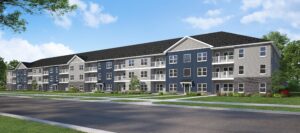
The new market rate apartments, located on Bierhaus Boulevard in Vincennes, will offer one-, two-, and three-bedroom options and were designed by Simplified Developments, LLC. Elite Construction Services, a Simplified Developments sister company, will provide construction services. The firms have designed and built multiple new housing units in Gibson, Vanderburgh, and Daviess counties.
“This new development will help satisfy local demand for market rate housing required for talent attraction and workforce expansion,” said Pfaff. “This is a strong strategic match that is expected to support economic growth in the Knox County region.”
For government and business leaders alike, the numbers are challenging. In addition to sufficient capital, an available and qualified workforce represent key factors in growing a region. Indiana and many other states face the dual challenges of an aging workforce and – with few exceptions – declining workforce numbers in the largest sectors: Gen Z, Millennials and Gen X. The handful of Indiana counties experiencing modest population growth draw on immigrant populations, not internal growth and development.
So how can Indiana compete and grow, especially regarding talent acquisition and retention?
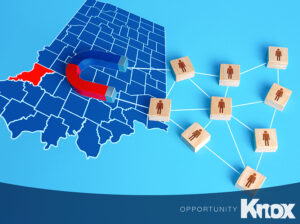 Research shows attraction factors include the availability of good-paying jobs with high levels of satisfaction, and a high quality of life. If a region can pair these up with a lower cost of living (compared to the high cost of living in places like New York City, Los Angeles, or Silicon Valley), they hold a decisive advantage.
For Indiana, that provides a ray of hope, particularly in our present tight labor market. Hoosier regions can join forces (and in several cases already are) to adopt more aggressive positioning, recruiting, and retaining talent. Indiana also holds an advantage in the top two triggers identified for relocation: No. 1 – to have a better quality of life, and No. 2 – the capacity to be closer to family.
(This column appeared on Inside Indiana Business and is used by permission.)